Welcome to Mesa Apostolic Lutheran Church
Living with Faith, Hope, Love, and Purpose.
SUMMER BREAK
Services will be cancelled from July 26-to the beginning of September.
We will post here when we know what Sunday services will resume.
Come visit us for worship
Sunday morning worship begins at 11:00am
Miss a sermon?
Did you miss a sermon, or want to listen to a past sermon? Check out our Sermon Library, or find us on Apple or Spotify.
Latest Sermon

About Us
The Mesa Apostolic Lutheran Church was established in Mesa, Arizona and later moved to Gilbert, where we continue to serve the local community today. For more than 30 years, our church has been a place of faith, fellowship, and steady commitment to God’s Word.
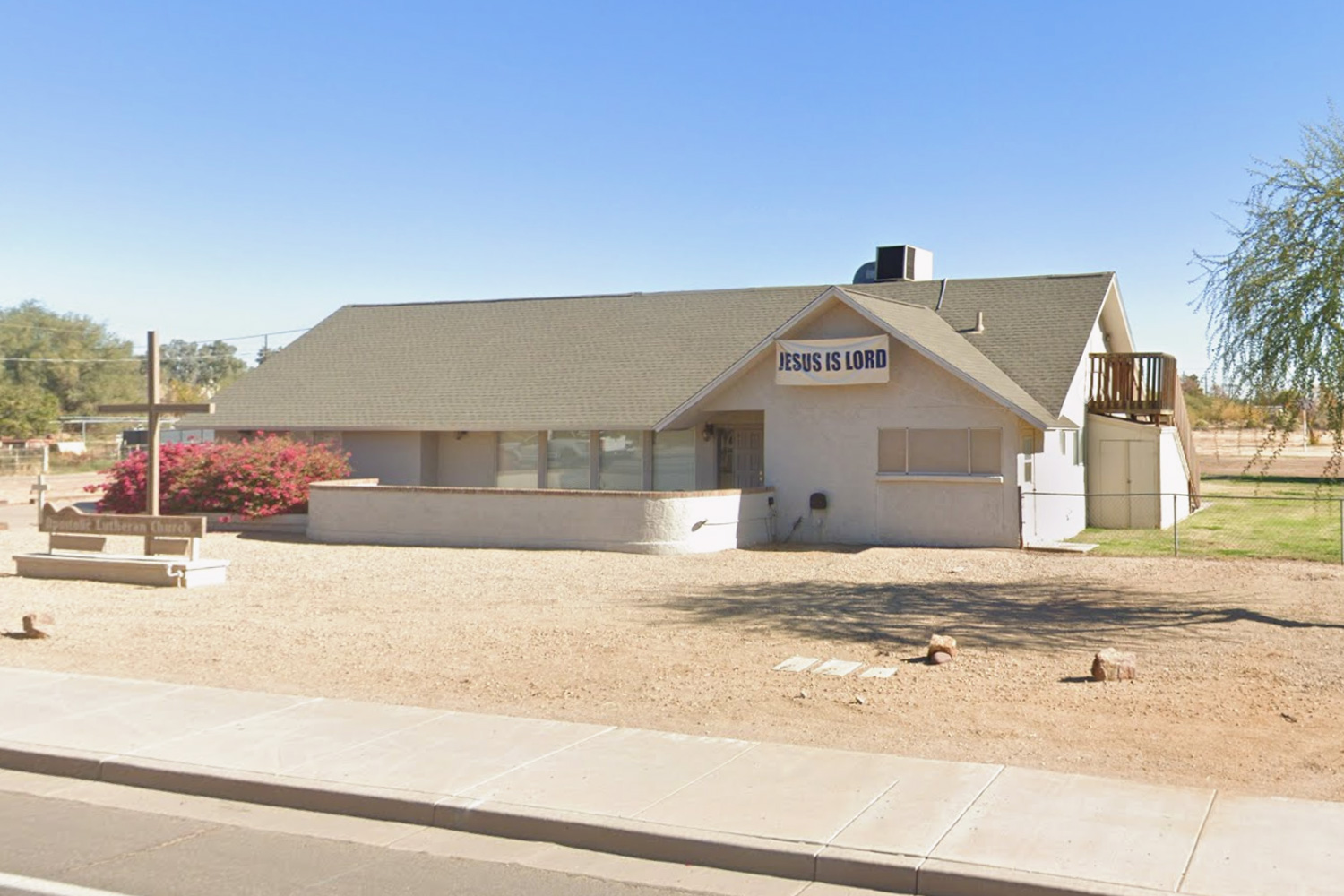
We are a small, close-knit congregation rooted in a shared love for Scripture and a desire to live according to God’s will. Our faith is not just something we practice on Sundays, but something we strive to carry into our daily lives through humility, integrity, and compassion for others.
At our core, we believe in teaching the Bible clearly and faithfully, encouraging one another in spiritual growth, and supporting our community through prayer and fellowship. Whether you are lifelong in your faith or simply seeking a place to learn and reflect, we welcome you to worship with us and be part of our church family.
Our History
The Apostolic Lutheran Church was organized in the United States in 1872, having its roots with a group of people who came from Finland, Sweden, and Norway in the 1860’s. The Apostolic Lutheran Church of America has 57 churches with about 9,000 members.
Known in Scandinavia as the Laestadian Movement, this church started as a revival or awakening in the parish of Kaaresuvanto in the northernmost part of the State Church of Sweden. It received its name from the minister, Lars Levi Laestadius. The immigrants who brought this movement to America were of Laestadian Lutheran background in their home countries. At first they attended other Lutheran Synods in America, but they desired to organize a congregation of their own. In 1872, they organized a congregation “Salomon Korteniemi Lutheran Society” in Calumet, Michigan having called Salomon Korteniemi from Norway to be their minister. Other congregations followed under various names, primarily in Michigan, Minnesota, Oregon, and Washington. The name “Finnish Apostolic Lutheran Church of Calumet” was adopted in 1879 and this was the first use of “Apostolic Lutheran” in our names.
Between 1892 and 1922 the original group divided into three main bodies. The Apostolic Lutheran Church of America is one of those starting in 1908. In 1928, the Finnish Apostolic Lutheran Church of America (Finnish was dropped in 1962) was officially incorporated under the laws of the State of Michigan and elected its first President, Pastor John Oberg, who served from 1928 to 1943. In 1943 Rev. Andrew Mickelsen became his successor serving until 1972. Others have followed him, chosen by the Central Board from among their members elected by the delegates at the Annual Business Meeting. Those that have served are Oscar Wilson, 1972- 1979; George Wilson, 1979-1987; Richard Sakrisson, 1987-1991; Ralph Davidson, 1991-1993; Earl Kaurala, 1993-1998; Richard Juuti, 1998 to 2007; Wilfred Sikkila, 2007 to present. All are ministers.
Apostolic Lutheranism, as a whole, has been and still is mostly a lay movement with ministerial training not a pre-requisite for ordination to the ministry. Evidence of a “call by God to preach the Word” is the main criteria for ordination of the clergy and elders. The church buildings in which members worship are very simple in structure and beauty. The worship service consists of a simple liturgy. A typical worship service includes an opening hymn, prayer, a hymn and free will offering, a sermon from the Bible, communion, and a closing hymn and benediction.
Each congregation in the Apostolic Lutheran Church is autonomous. The Apostolic Lutheran Federation presently has 43 ministers on the Ordained Ministerial Roll, 33 ministers on the Unordained Ministerial Roll. The Western Mission, the Eastern Mission and the Southern Mission coordinate domestic mission activities in the United States and Canada. The Foreign Mission sends missionaries to several other countries around the world. Other Federation activities include the National Sunday School, Book Concern, and a monthly publication of Christian writings called “The Christian Monthly.” Headquarters are at PO Box 2948, Battle Ground, WA 98604-2948. Website: www.apostolic-lutheran.org.
Statement of Faith
The Apostolic Lutheran Church of America recognizes as true, the Christian Doctrine, based on the Old and New Testaments of the Holy Bible, the Lutheran Doctrine, and the Book of Concord, and the three ecumenical symbols: the Apostolic, the Nicene, the Athanasian [Creeds, as well as the], and the Augsburg Confessions, (those parts) which are in agreement with the Holy Bible and uphold the Confession of True Faith, and love as the greatest law.
All ritual and polity of the Church are to be governed according to the immovable truths of the above mentioned Confessions, namely, that the Holy Word of God (both the Old and New Testaments) shall be the sole authority of truth in the light of which all doctrine in this Church shall be examined and determined.
The principal calling (duty) of this Church shall be the propagation of the true doctrine, which shall manifest itself in the preaching of repentance and the remission (forgiveness) of sins, and by the administration of the sacraments of Holy Baptism and the Lord’s Supper customarily practiced by the Apostolic Lutheran Churches. The Apostolic Lutheran Church emphasizes the importance of a personal experience of justification by faith (salvation experience).